As part of the Society for Classical Studies, this initiative supports projects which create pathways for knowledge exchange about the ancient world beyond the classroom to engage broader publics.
We’ll be using this funding to cover some of our start-up costs, such as commissioning Jenni Perdzock for our amazing logo, and to advertise AATAW to potential new viewers and lecturers! Check out more of Jenni’s work here.
If you’re interested in creating a video lecture with AATAW, check out our Call for Papers! We’ll be reviewing abstracts due September 1st, 2022!
Alt Text The Ancient Worlds, Modern Communities logo.
Nervous about recording a video lecture? We can show you how!
In this video, we cover the basics of how to record with PowerPoint, Zoom, Panopto, and OBS Studio. You’ll also learn how to record in the style of “traditional online lectures” and “YouTube video essays.” This video is great for Early Career Researchers presenting with AATAW, teachers leading online classes or delivering remote instruction, scholars presenting at virtual or hybrid academic conferences, and any beginner who wants to learn how to record a basic video lecture!
Check out our presenter guidelines for more suggestions on creating video lectures.
We’re thrilled to announce a special lecture by a member of our very own AATAW team. Miranda Lovett presents “African Subjects in Greek Pottery: A Call for Comprehensive Interpretation.”
Miranda Lovett is the current Public Programs Intern at the Getty Villa Museum. She is interested in Greek art and archaeology, particularly in the Bronze Age and Archaic period, ancient identity, and modern reception of antiquity. Miranda received her B.A. in Classics at the University of Mary Washington and her M.A. in Classical Archaeology at the University of Arizona.
Her presentation highlights issues with how scholars present and interpret depictions of Africans in Greek pottery.
Miranda provided us with the following abstract:
“Depictions of Africans in Greek pottery have long been studied by archaeologists and historians, but interpretations about why the Greeks chose these subjects continue to change. Even when dismissing the blatant racism of early scholarship, modern scholars struggle to present these subjects without using inappropriate or outdated terminology or reducing Africans to mere slaves. As stewards of antiquity, academics and museum professionals alike are responsible for providing interpretations that make sense within the context of antiquity and within modernity. Focusing on a single object in the Getty Villa collection, an Athenian wine pitcher, this paper discusses what is known about the Greek context of this vessel, issues of terminology, and the role modern museums play in presenting racialized subjects.”
Miranda has not asked us to share any content warnings with our audience.
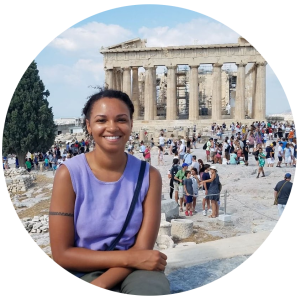
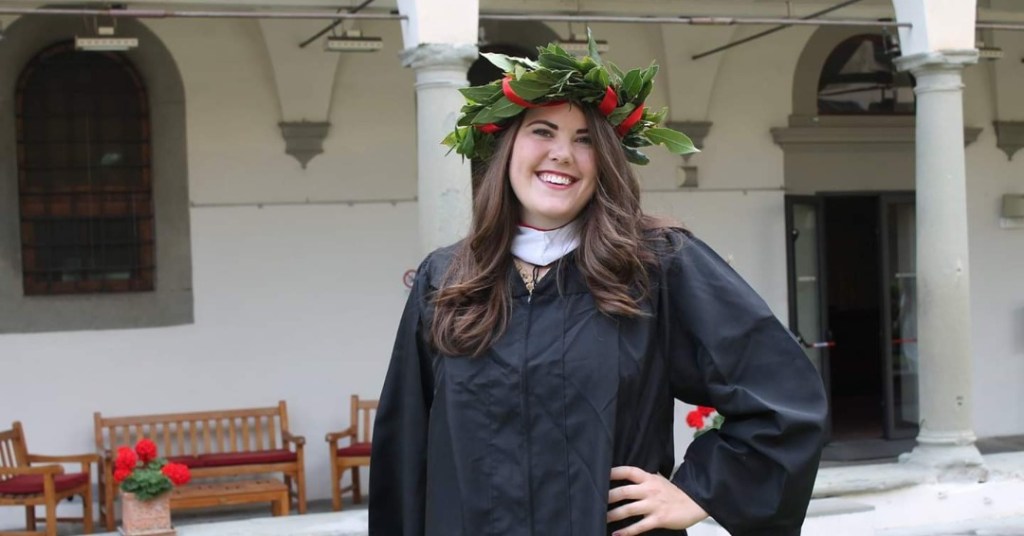
Welcome to our newest team member, Miranda Lovett!
Miranda is the current Graduate Intern for the Public Programs Department at the Getty Villa Museum. She is interested in Greek art and archaeology, particularly in the Bronze Age and Archaic period, and exploring how these subjects intersect with the experiences of modern people. She has participated in two Greek archaeological excavations: the Despotiko excavation in the Cycladic Islands and the Mt. Lykaion Excavation and Survey Project in the Peloponnese. Miranda wants to pursue a museum career where she can join her love for Classical antiquity and her passion for making the ancient world accessible to diverse audiences.
Miranda became interested in the ancient world in high school where she was introduced to Greek mythology. This led her to take ancient Greek language courses throughout her undergraduate education. Upon taking Greek and Roman art history courses to fulfill the Classics major, she realized she had found her passion and pursued her Master’s in Classical Archaeology.
We are happy to announce our first presenter for April, Chana Algarvio, with her presentation “Stone and Ancient Egyptian Book Culture.”
Chana Algarvio has a MA in Near and Middle Eastern Civilizations from the University of Toronto, with a specialization in Egyptology that focused on cross-cultural relations via art practices and iconography. Currently she is a Master of Information candidate at the University of Toronto pursuing Library Science, and Book History and Print Culture. Her research focuses on challenging Western notions and modern bias regarding the book by shedding light on the realities of ancient Egyptian book culture, a culture which was not solely papyrus-based, as is commonly believed.
Her presentation focuses on how stone was a fundamental writing surface in ancient Egypt, and how book historical scholarship, as well as Egyptological scholarship, often neglects stone as a book medium.
She has provided us with the following abstract:
“There is a neglect or hesitancy in modern scholarship—whether in Egyptology or Ancient Near Eastern studies, and especially in book history—to consider stone as a book medium due to the seminal focus placed on portability as a defining characteristic of the book. Based on Western concepts and early-modern bias that ultimately equates codex to book, the notion of portability is ultimately inapplicable to all book cultures and deserves reexamination. Throughout ancient Egyptian history, stone was used as a primary writing surface to communicate with humans and the divine. This presentation will look at the various uses of stone in ancient Egyptian book culture and the literary works inscribed, conceptual frameworks that can be used to better understand how stone can be considered a carrier for the book, and will discuss other ways in which portability can be achieved via non-physical means.”
We are happy to announce our second presenter for March, Louis Polcin, with his presentation “Diplomacy and Security in the Ancient World: Hasmonean-Roman Relations.” Louis is a graduate student in the interdisciplinary Classical, Near Eastern and Religious Studies department at the University of British Columbia. His research interests include Greco-Jewish cultural interactions in the Hellenistic period, and Judean political institutions in the Hellenistic and early Roman eras. He was a History and Classical Studies double major as an undergraduate at Willamette University. Today’s presentation stems from his History thesis, which seeks to re-evaluate perhaps the earliest interactions between Jews and Romans: the military alliances between the Hasmonean Dynasty and the Roman Republic. You can follow him on Facebook (@Louis Polcin).
His presentation focuses on Hasmonean-Roman relations and geopolitical strategies in the 2nd century BCE.
He has provided us with the following abstract:
“Scholars have long been puzzled by the treaties between the Hasmonean Dynasty of Judea during the second century BCE, and the Roman Republic, which ruled much of the Western Mediterranean during the same period. The geographic, political, religious and cultural differences between the two states, as well as the enormous power differential between them, has caused skepticism over their mutual cooperation. Yet placed within the larger geopolitical context of the ancient Mediterranean, these treaties become quite sensible. This study argues that Hasmonean-Roman relations illustrate the geopolitical strategies of each regime; while Rome sought to use the Hasmoneans as a buffer against their rivals, the Hasmoneans attempted to use the backing of Rome to intimidate both internal and external opponents. Far from victims of Rome manipulation, the Hasmoneans overdramatized the threat that their own enemies could pose to Rome, allowing them to obtain sweeping rhetorical concessions from the Roman Senate.”
We are happy to announce our first presenter for March, Rafaela Brosnan, with her presentation “About Face: Female Frontality in the Khorsabad Ivories.” Rafaela Brosnan is currently the John Wilmerding Intern for Digital Interpretation at the National Gallery of Art in Washington, DC. She earned her master’s degree with specializations in Ancient Near Eastern Art and Archaeology and Curatorial Studies from the University of Chicago in 2020. Rafaela’s research interests include gender and sexuality in the ancient world, displaced objects, and social justice in the museum field. You can follow her on Facebook (facebook.com/rafaela.brosnan) and Instagram (@rafaela.bros)
Her presentation focuses on the role of female frontality, gender in composite creatures, and the unstable meanings of the Khorsabad ivory sphinxes in a cross-cultural context.
She has provided us with the following abstract:
“The Syro-Phoenician Wig and Wing ivory sphinxes excavated in Khorsabad (ancient Dur-Sharrukin) bear intriguing faces that demonstrate the power of female frontality, a composition that is still largely unexplored in scholarship on ancient Near Eastern art. In contrast to the frameworks of originality and hybridity that typically characterize this subject, this presentation examines the role of female frontality, gender in composite creatures, and the unstable meanings of the Khorsabad ivory sphinxes in a cross-cultural context. By exploring the ivories’ relationship to the ancient city of Dur-Sharrukin, I argue the ivories’ gendered frontal pose presents an innovative divergence from their Phoenician counterparts, transforming the Wig and Wing sphinxes and the specific connotations they are able to carry in a variety of contexts. This is due to the ability of female frontality to signal meanings based on the affective nature of sight in relation to knowledge, gender, and Assyrian customs.”
We are happy to announce our third presenter, Sara Myers, with her presentation “Benvenuto Cellini’s Perseus with the Head of Medusa – The Meaning Behind the Violence.” Sara received her MA in Classical Art and Archaeology from the University of Colorado Boulder and her BA in Classics with a minor in Art History from Brigham Young University. She has worked at both the Denver Art Museum and the Children’s Museum of Denver as a museum educator. Her interests lie in the artistic representation of classical mythology throughout history. You can follow her on Facebook (facebook.com/sara.myers.7503) and Instagram (@smyers778)
Her presentation focuses on the 16th century depiction of Perseus and Medusa commissioned by Cosimo I de’ Medici and completed by Benvenuto Cellini.
She has provided us with the following abstract:
“Commissioned by Cosimo I de ‘Medici shortly after his appointment as Grand Duke, the famous bronze sculpture of Perseus with the Head of Medusa completed by Benvenuto Cellini in 1554 uses the myth of the great hero Perseus to serve as a visual representation of Cosimo’s rise to power as well as act as a warning to the enemies of the Medici. The mythological symbolism, the location of the statue, the supplemental imagery found on the base of the bronze, as well as surrounding artwork all lend themselves to the idea that this statue was commissioned to commemorate a critical event in Cosimo I de ‘Medici’s rise to power. This presentation takes a closer look at the context, the myth, and the statue as a whole to fully appreciate the thought that went into the commission of this statue. I explore how a story frequently told and depicted in the ancient world was effectively used to make a bold statement about Cosimo I de’ Medici and visually cemented his claim to power in Florence.”
We are happy to announce our first presenter for November, Dr. Katherine Iselin, with her presentation “Textiles: Women’s Work Art”. Dr. Iselin received her PhD in Art History and Archaeology from the University of Missouri, and she currently teaches in the Department of Women’s and Gender Studies at the University of Missouri. Her research explores themes of gender and sexuality in visual and material culture, particularly through the reception of ancient art in later periods. You can follow Dr. Iselin on Twitter (@Ktpiselin) and Instagram (@ktp.iselin).
Her presentation focuses on how women contributed to the visual arts in ancient Greece. She has provided us with the following abstract:
“How did women contribute to the visual arts in ancient Greece? Discussions on the art of ancient Greece typically focus on sculpture and vase-painting – unsurprising as these two forms of art not only most commonly survive, but sculpture and painting remain the most highly-regarded of all artistic mediums in the Western art world. As they have been for much of Western art history, these media were largely produced by men. Thus, women are frequently absent from discussions of ancient Greek art. Yet ancient Greek women were involved in visual art in other ways – most notably through textile arts.
Textiles rarely survive from antiquity. Even so, with the handful of extant fragments, depictions of weaving on vase-painting, and the surviving objects associated with weaving activities, we can gain a better understanding of this particular form of art so closely associated with women. This video gives an overview of the association between women and weaving, examining the significance of textiles in ancient Greece and showing the weaving process.”
AATAW is now partnered with Save Ancient Studies Alliance! SASA works to promote study of the ancient world and to build an inclusive community of learners and students. Check out their website and Port Ancient, their partner project gallery.





 All About The Ancient World