
Categories
Earlier Lectures Lectures

“Benvenuto Cellini’s Perseus with the Head of Medusa – the Meaning Behind the Violence” by Sara Myers

We are happy to announce our third presenter, Sara Myers, with her presentation “Benvenuto Cellini’s Perseus with the Head of Medusa – The Meaning Behind the Violence.” Sara received her MA in Classical Art and Archaeology from the University of Colorado Boulder and her BA in Classics with a minor in Art History from Brigham Young University. She has worked at both the Denver Art Museum and the Children’s Museum of Denver as a museum educator. Her interests lie in the artistic representation of classical mythology throughout history. You can follow her on Facebook (facebook.com/sara.myers.7503) and Instagram (@smyers778)
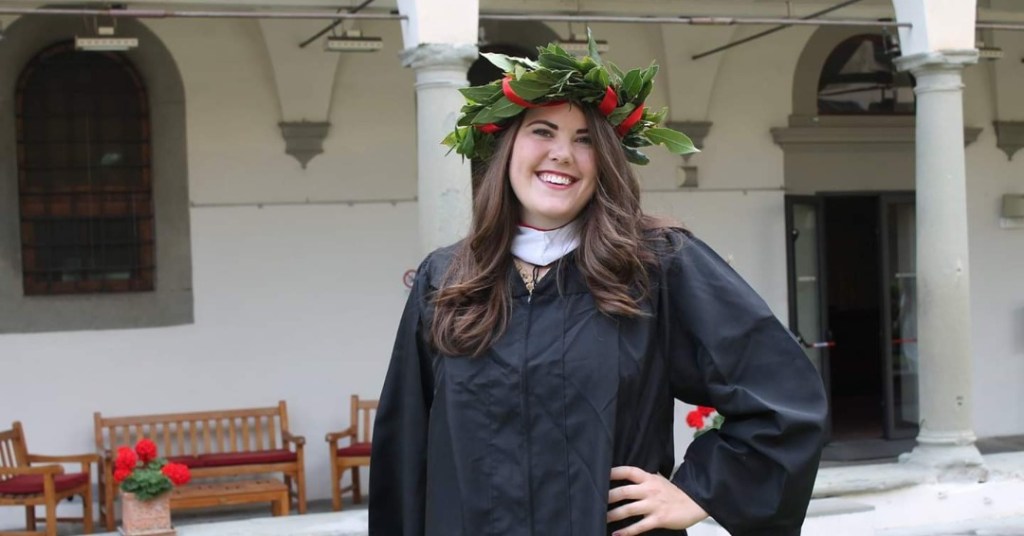
Her presentation focuses on the 16th century depiction of Perseus and Medusa commissioned by Cosimo I de’ Medici and completed by Benvenuto Cellini.

 She has provided us with the following abstract:

“Commissioned by Cosimo I de ‘Medici shortly after his appointment as Grand Duke, the famous bronze sculpture of Perseus with the Head of Medusa completed by Benvenuto Cellini in 1554 uses the myth of the great hero Perseus to serve as a visual representation of Cosimo’s rise to power as well as act as a warning to the enemies of the Medici. The mythological symbolism, the location of the statue, the supplemental imagery found on the base of the bronze, as well as surrounding artwork all lend themselves to the idea that this statue was commissioned to commemorate a critical event in Cosimo I de ‘Medici’s rise to power. This presentation takes a closer look at the context, the myth, and the statue as a whole to fully appreciate the thought that went into the commission of this statue. I explore how a story frequently told and depicted in the ancient world was effectively used to make a bold statement about Cosimo I de’ Medici and visually cemented his claim to power in Florence.”

Categories
Earlier Lectures Lectures

“Textiles: Women’s /Work/ Art” by Dr. Katherine Iselin

We are happy to announce our first presenter for November, Dr. Katherine Iselin, with her presentation “Textiles: Women’s Work Art”. Dr. Iselin received her PhD in Art History and Archaeology from the University of Missouri, and she currently teaches in the Department of Women’s and Gender Studies at the University of Missouri. Her research explores themes of gender and sexuality in visual and material culture, particularly through the reception of ancient art in later periods. You can follow Dr. Iselin on Twitter (@Ktpiselin) and Instagram (@ktp.iselin).

Her presentation focuses on how women contributed to the visual arts in ancient Greece. She has provided us with the following abstract:

“How did women contribute to the visual arts in ancient Greece? Discussions on the art of ancient Greece typically focus on sculpture and vase-painting – unsurprising as these two forms of art not only most commonly survive, but sculpture and painting remain the most highly-regarded of all artistic mediums in the Western art world. As they have been for much of Western art history, these media were largely produced by men. Thus, women are frequently absent from discussions of ancient Greek art. Yet ancient Greek women were involved in visual art in other ways – most notably through textile arts.

Textiles rarely survive from antiquity. Even so, with the handful of extant fragments, depictions of weaving on vase-painting, and the surviving objects associated with weaving activities, we can gain a better understanding of this particular form of art so closely associated with women. This video gives an overview of the association between women and weaving, examining the significance of textiles in ancient Greece and showing the weaving process.”

Categories
Earlier Lectures Lectures

“Doctor, doctor, gimme the news: Diagnosis 2000 years removed” by Susanna Pilny

We are happy to announce our first presenter for October, Susanna Pilny, with her presentation “Doctor, doctor, gimme the news: Diagnosis 2000 years removed.” Susanna has an MPhil in Classics from Trinity College Dublin and an MSc in Biological and Biomolecular Science, with a focus on microbiology and infection biology, from University College Dublin. She is currently a data analyst, but still spends her summers volunteering at the Agora Excavations in Athens (during non-Covid years) and her spare time pursuing independent scholarship. You can follow Susanna on Twitter (@plinytheshorter).

Her presentation focuses on how to diagnose ancient illnesses. She has provided us with the following abstract:

“We often take it at face value when experts tell us that ancient peoples suffered from specific diseases. But how do you go about diagnosing someone who is 2000 years dead? And how confident can you really be in this diagnosis? 

I will walk viewers through the pitfalls of attempting to diagnose the diseases of people long past. Problems include: differences in modern and ancient understanding of health, disease, and medicine; translation problems; diseases that no longer exist; and genetic mutations of current diseases. Then, using malaria in Classical Greece as an example, I will explain how one might attempt a retrospective diagnosis. This discussion will broadly use modern scientific knowledge to analyze textual and archaeological evidence from ancient Greece.”

Susanna has asked us to share the following content warnings with our audience: human remains (i.e. bones) will be shown.